Overview
Shani Shingnapur Temple is one of India's most revered shrines dedicated to Lord Shani (Saturn). Located in Ahmednagar district of Maharashtra, the temple is famous for its self-manifested black stone idol installed under the open sky and the unique tradition of houses without doors, symbolizing the deity's divine protection.
History & Mythology
Historical Timeline
Shani Shingnapur Temple, situated in Shingnapur village of Ahmednagar district, Maharashtra, is among the most significant pilgrimage centers dedicated to Lord Shani. Although no inscriptions precisely date its origin, local traditions suggest that the temple has been worshipped for several centuries.
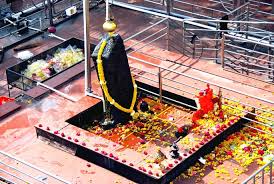
The temple gained prominence after villagers discovered a mysterious black stone on the banks of the Panasnala stream following heavy floods. The stone was later recognized as the self-manifested form (Swayambhu) of Lord Shani. As instructed in a divine vision, the stone was installed on an open platform without constructing a roof or sanctum.
Over the centuries, the temple evolved from a small village shrine into one of Maharashtra's largest pilgrimage destinations. Today, it is managed by the Shri Shaneshwar Devasthan Trust and attracts millions of devotees annually from across India and abroad.
Mythology (Puranic Significance)
According to legend, after heavy rains, villagers discovered a large black stone near the Panasnala stream. When a shepherd touched the stone with a stick, blood flowed from it.That night, Lord Shani appeared in the dreams of the village headman and revealed that the stone was His self-manifested form. He instructed that the idol should never be enclosed by walls or a roof, as He wished to remain beneath the open sky.Lord Shani further promised to protect the village from theft and injustice. This belief gave rise to the famous tradition of homes without doors or locks. Even today, many villagers believe that Lord Shani himself punishes wrongdoers.Devotees also believe that worshipping here reduces the adverse effects of Shani Dosha, Sade Sati, and Dhaiya.
Kings & Dynasties
Unlike many ancient temples, Shani Shingnapur was not established by any known royal dynasty. Its growth has primarily been supported by:
Local village communities,Maratha rulers who patronized regional temples,Devotees across India,Shri Shaneshwar Devasthan Trust
The temple developed largely through public devotion rather than royal patronage.
Associated Saints
According to Dr. Binduji Maharaj, a disciple of Swami Niravandas Udasin from Trimbakeshwar, the worship and traditions of Shani Shingnapur Temple have been followed according to the teachings of the Udasin saints for many years. Other respected saints, including Shri Pancharameshwar Jamaat and Sant Maheshwar Das Udasin of Allahabad, have also praised the temple, saying that many devotees have experienced divine blessings and miracles here. They believe the temple is a sacred place that reflects the rich spiritual and religious traditions of Hinduism. A long-standing custom at the temple is for devotees to wear saffron robes (Bhagava Vastra) and a loin cloth (Kati Vastra) while performing rituals such as darshan (viewing the deity) and abhishek (ritual bathing of the idol). Devotees believe that worshipping Lord Shani with devotion brings peace, prosperity, and protection.
Architectural Marvels
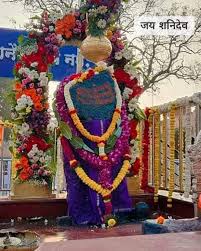
The architecture of Shani Shingnapur Temple is unique and different from that of most traditional Hindu temples. The temple does not have a roof or a conventional Garbhagriha (sanctum sanctorum). Instead, the self-manifested (Swayambhu) black stone idol of Lord Shani, which stands about 5 feet 9 inches tall, is placed on an open platform under the sky. According to local belief, Lord Shani himself wished to remain uncovered, and therefore no roof has ever been built over the idol. The temple complex has marble flooring around the platform, a spacious queue system for devotees, a large Sabha Mandap for religious gatherings, and a designated area where devotees offer sesame oil to the deity. Modern facilities have also been developed for the convenience of pilgrims, including separate pathways for darshan and ritual offerings. The simple yet distinctive architecture reflects the temple's spiritual significance, emphasizing faith, humility, and the unique tradition of worshipping Lord Shani under the open sky.
Cultural Tapestry
Festivals
Shani Jayanti (largest annual festival),Every Saturday (weekly special worship),Shani Amavasya,Hanuman Jayanti,Diwali,Kartik Purnima,Ashwin Navratri
Culture & Traditions
Houses traditionally built without doors or locks,Offering,Sesame oil to Lord Shani,Black sesame seed offerings,Black cloth offerings,Circumambulation of the idol
Chanting Shani Stotra and Shani Chalisa
Karma-based worship emphasizing justice and righteousness
Handlooms & Textiles
Traditional Sarees
Paithani,Nauvari Saree,Narayan Peth Saree,Ilkat Saree,Cotton Maharashtrian Sarees
Local Textiles
Paithani Silk,Himroo,Mashru Fabric,Yeola Silk Sarees,
Handwoven Cotton Textiles
Photo Gallery

Visitor Information
-
Best Time to Visit
October to March (pleasant weather), Saturdays throughout the year ,Shani Jayanti ,Shani Amavasya
-
Temple Timings
Opening: 4:00 AM
Kakad Aarti: 4:30 AM
General Darshan: 5:00 AM – 10:00 PM
Evening Aarti: Around Sunset
Temple closes: 10:00 PM
How to Reach
Land Commute
City Distance Travel Time
Shirdi 72 km 1 hr 30 min
Ahmednagar 35 km 50 min
Aurangabad 85 km 2 hrs
Pune 165 km 4 hrs
Nashik 145 km 3 hrs
Mumbai 290 km 6 hrs
Shirdi 72 km 1 hr 30 min
Ahmednagar 35 km 50 min
Aurangabad 85 km 2 hrs
Pune 165 km 4 hrs
Nashik 145 km 3 hrs
Mumbai 290 km 6 hrs
Explore Nearby
Food Exploration
Maharashtrian Thali,Puran Poli,Misal Pav,Bharli Vangi,Zunka Bhakar,Pithla Bhakri,Sabudana Khichdi,Kanda Bhaji,Shrikhand,Basundi,Jalebi,Sugarcane Juice
Other Temples (100km radius)
Shri Sai Baba Temple, Shirdi 72 km,,
Khandoba Temple, Shirdi 71 km,,
Mohata Devi Temple 18 km,,
Siddhatek Siddhivinayak Temple 95 km,,
Renuka Mata Temple, Nevasa 50 km,,
Mhalsa Narayani Temple, Nevasa 49 km,,
Mohiniraj Temple, Nevasa 50 km,,
Chandi Devi Temple 42 km,,